

In many classrooms, teaching the BC Core Competencies can feel abstract. We talk about thinking, communication, and personal awareness as big ideas — sometimes so big that even adults struggle to describe what they look like in action. But in one kindergarten classroom, those competencies are visible, physical, and part of the daily language students use to understand themselves.
We sat down with Caterina Gabriele to talk about how she brings the Core Competencies to life.
For teachers who find the Core Competencies abstract, how do you explain them in simple terms?
Caterina: I usually explain them as the ways we think, share, and understand ourselves while we’re learning. We try to name them in many of the activities happening in the classroom every day. The Core Competencies help us name those moments and make them visible for students. Instead of feeling like something separate or something “big,” they become part of what we’re already doing. We’re just learning the language for it.
Why do you think it’s important to teach the Core Competencies explicitly in kindergarten?
Caterina: Kindergarten students don’t have the language yet for understanding the Core Competencies. If we name them and show what they look like and feel like, students can start to recognize them in themselves. At this age, learning needs to be explicit. It helps students understand that these skills are something they are actively using, not something abstract or just for older students. If we don’t give them the language, it just goes over their heads.
You’ve worked with older students before. How did you have to adjust when you moved into kindergarten?
Caterina: In intermediate, the kids already had vocabulary. By the time I was working with Grade 5, 6, or 7 students, I could have more realistic conversations like, “How did you communicate that message? Do you think you communicated it clearly? Could you have changed your tone?” They already understood where communication comes from and how messages work.
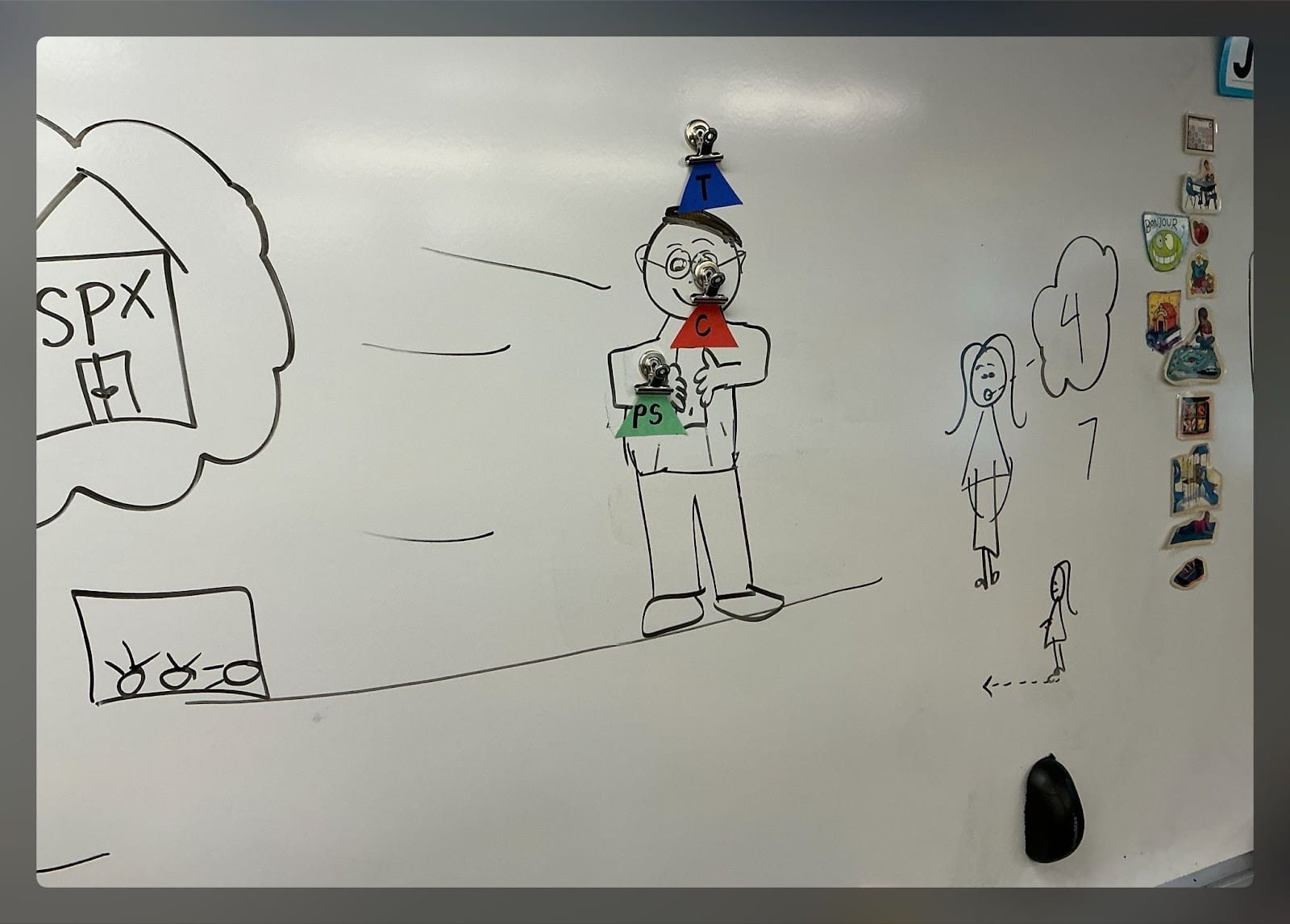
In kindergarten, I took everything down about fifteen steps. Even the tone I’m talking in right now is the tone I would use with older students. When I came into kindergarten, everything became theatrical: bright, almost Disney-like. We don’t even know yet where we communicate from. So we have to learn that first. We’re in a body. Where does communication come from? My mouth. Where does thinking come from? My brain. Where does Personal and Social come from? My heart. That’s how the drawing of someone on the board came from: we draw it, we point to it, and we talk about how they’re all connected.
Can you describe this drawing strategy you use to make the Core Competencies visible?
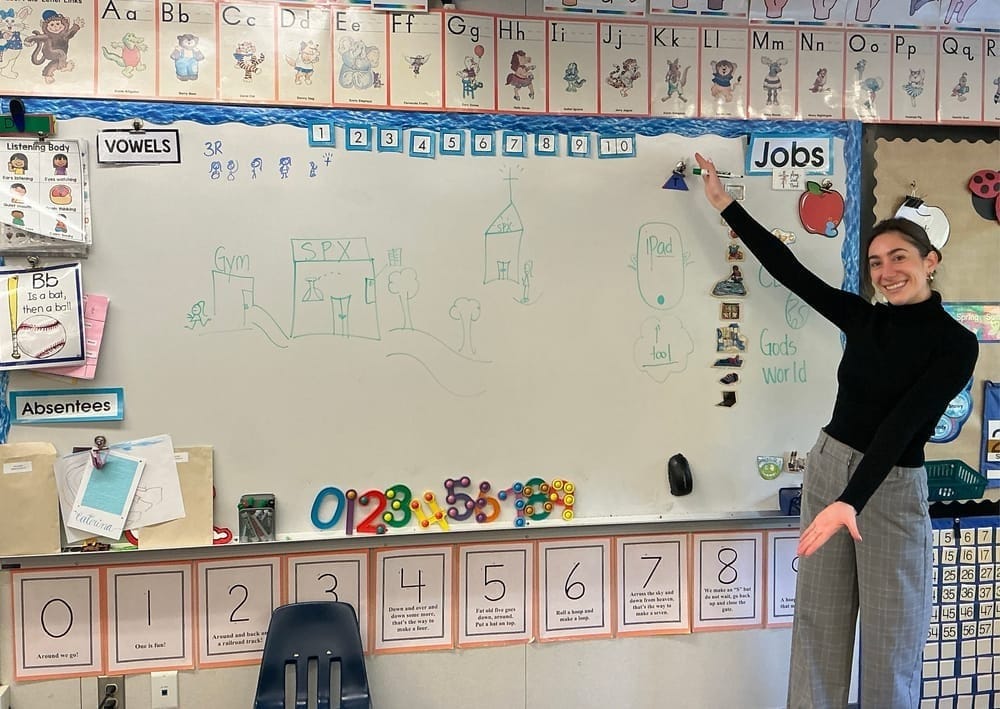
Caterina: I draw a simple figure on the whiteboard, usually representing myself or sometimes a student. Then I use magnets for each of the Core Competencies and place them on different parts of the body as we talk about what we’re doing. Critical Thinking goes near the head because that’s our thinking brain. Communication goes near the mouth because that’s how we share messages. Personal and Social goes near the heart because that’s where feelings and relationships connect. It becomes a visual reference we return to all day. It’s something we keep revisiting.
Do you think your background as a performer plays a role in how you teach this way?
Caterina: Absolutely! Whenever I talk to colleagues and I mention that I grew up on stage (that I was a competitive dancer) they always say, “Oh, you can tell.” And it’s true. Everything I do in my class is linked to that part of me. When I’m teaching, I’m on. Even though I’m not dancing anymore, it still feels like I’m on stage. That performance energy helps me make things animated and physical, and I think that’s part of why connecting competencies to the body feels natural for me. It’s just how I experience learning.
You talk a lot about learning through the body. Why is that so important in kindergarten?
Caterina: In child development, we know the best way for young students to learn is kinaesthetically. If we’re learning through our body, through our senses, through movement and touch, we’re going to ingest and digest information better. That leads to retention, and that’s what we want. Research suggests that when it’s only verbal instruction, you lose a large percentage of your class. There has to be something visual, something sensory, something participatory. The kids have to move. They have to share their ideas. They have to hear their own language.
My cohort at UBC used to call it peanut butter and jelly: the kind of education that sticks. You’ve made a really good PB&J sandwich that day: the kids were involved, they were moving, they were asking questions, they were revisiting ideas, and they were using the Core Competencies naturally.
How do students respond over time? When do you start seeing them use the language themselves?
Caterina: It takes repetition — pretty much all of September and October. My entire month of October is language development. We talk about feelings. We practice “I Messages” like “I can…” “I feel…” “I need…” It’s language, language, language. By November, you start to hear students using “I Messages” independently. A child will say, “I didn’t like it when you took my toy. It made me feel upset.” That’s Communication and Personal and Social working together.
Critical Thinking takes a bit longer. Sometimes I see that language come out in February, sometimes after spring break if it’s a bigger class. But communication happens first. They pick up my speech quickly and start using it themselves.
How does this groundwork affect your assessment?
Caterina: It makes assessment much easier. Honestly, I feel like I can’t assess properly if I don’t give them this language first. If we don’t set this groundwork, I can’t run the class the way I want to. My language would just go right over their heads. A lot of assessment in kindergarten is connected to how they feel, how they communicate, and whether they can think of a different message. If we didn’t spend those six weeks building vocabulary, I don’t think 75–80% of my assessments would be as strong.
Kindergarten has its own vocabulary. We speak it every day. That shared language is what allows me to see their growth.
We’ve collaborated with you during outdoor learning at Little Cates Park. How do those experiences support competency development?
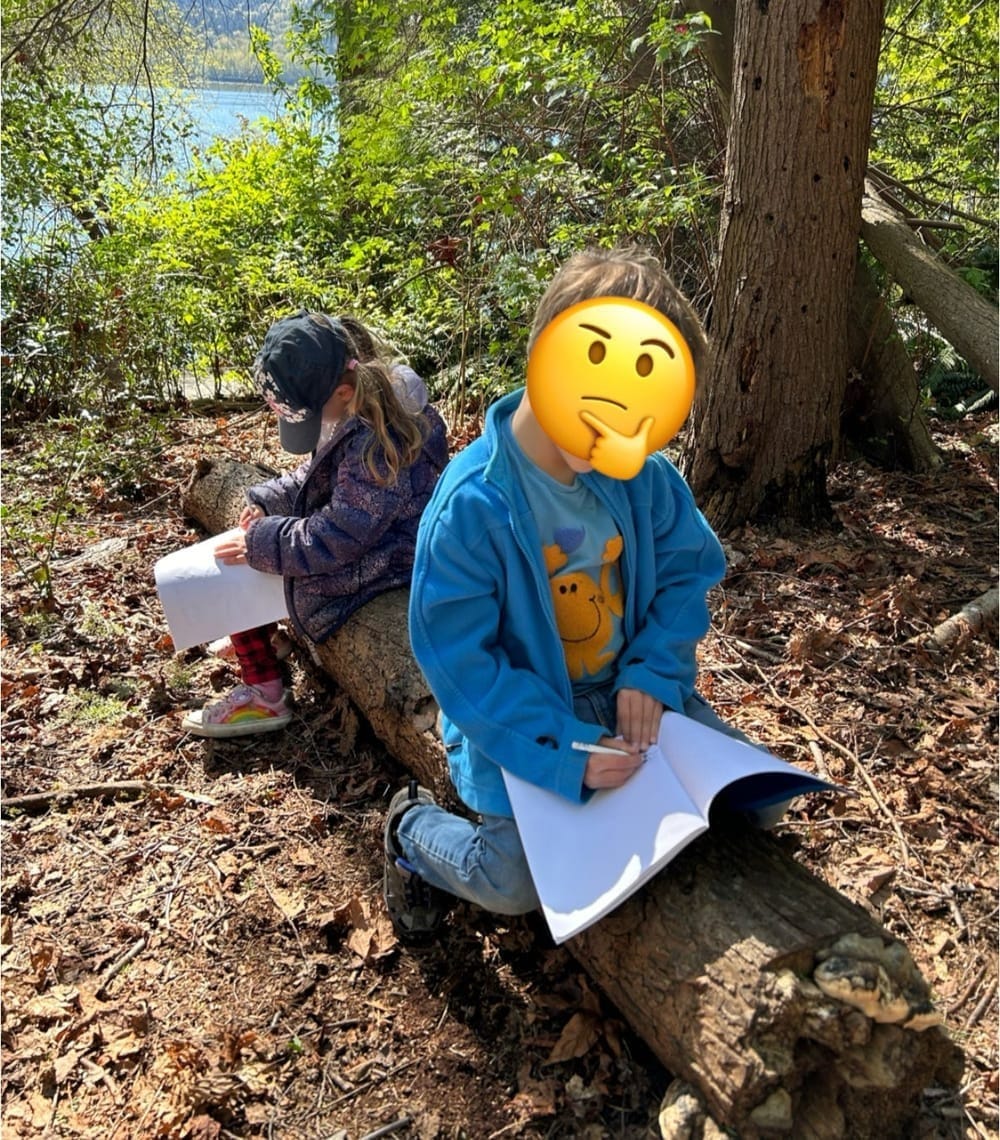
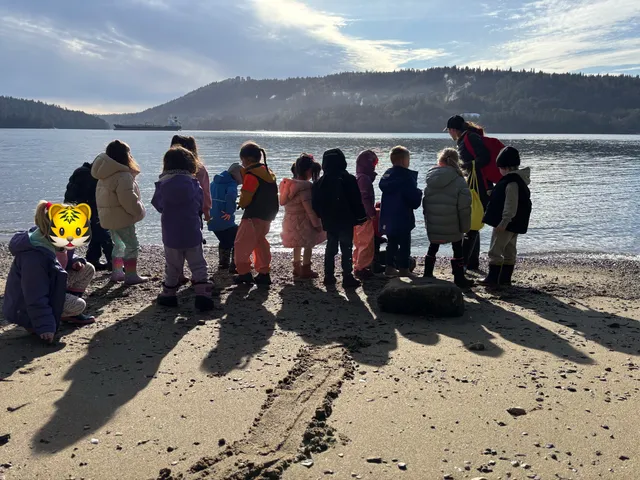
Caterina: Outdoor experiences give students space to observe, move, and respond in different ways. At the park, students are making choices, describing what they notice, and expressing how they feel. We practice making two-part statements like, “I like the trees. They make me feel calm.” That’s science observation and language arts happening together, but it’s also Personal and Social awareness. The outdoors creates natural opportunities for reflection.
How do tools like iPads and Seesaw support this approach?
Caterina: We use them for students to record videos of what they observe and how they feel. It captures learning that might be missed if we relied only on written work. Back in the classroom, we record students recalling what they did and how it made them feel. We can share that with families right away so they can see exactly where their child is developmentally. It becomes authentic evidence of growth.
Do you think there are misconceptions about teaching competencies in kindergarten?
Caterina: I think some people see it as abstract. But I really believe this works at all ages. If someone moved me to Grade 7 tomorrow, I would still draw myself on the board and place the magnets. It would take me one day instead of six weeks, but I would still do it. Just like picture books work at all ages, visuals and storyboards work at all ages. When you make learning visible, it connects.
What would you say to teachers who feel hesitant about open-ended or competency-based work?
Caterina: Start small. Be clear about the learning before you take students outside or try something new. It’s okay if some students struggle — we’re not looking for everyone to be the same. We’re looking for effort and growth. I truly believe students are more capable than we think. You just have to try it. And of course, it helps to have Classmate collaborate in the process.
Finally, what do you hope your students carry with them when they leave kindergarten?
Caterina: Personal and Social comes first. That’s a life skill — being able to feel feelings and stay self-regulated. Grades matter less to me than whether they can express themselves and manage their emotions. If they can communicate well, they’re moving up the ladder. If they can think of new ideas, they’re moving mountains. But self-regulation — that’s the foundation.
If the Core Competencies ever feel too abstract, Caterina’s classroom offers a simple reminder: five-year-olds don’t need more definitions — they need anchors. A storyboard, a magnet, a repeated phrase, a moment to reflect. Over time, the language becomes real.
Kindergarten Cop!
If all this sounds like being too nice and way too patient with kids, here’s what it looks like when Arnold Schwarzenegger becomes a kindergarten teacher. It’s a good reminder of why intentional (and compassionate!) language, routines, and strategies (like the ones Caterina uses!) matter so much in real classrooms.