

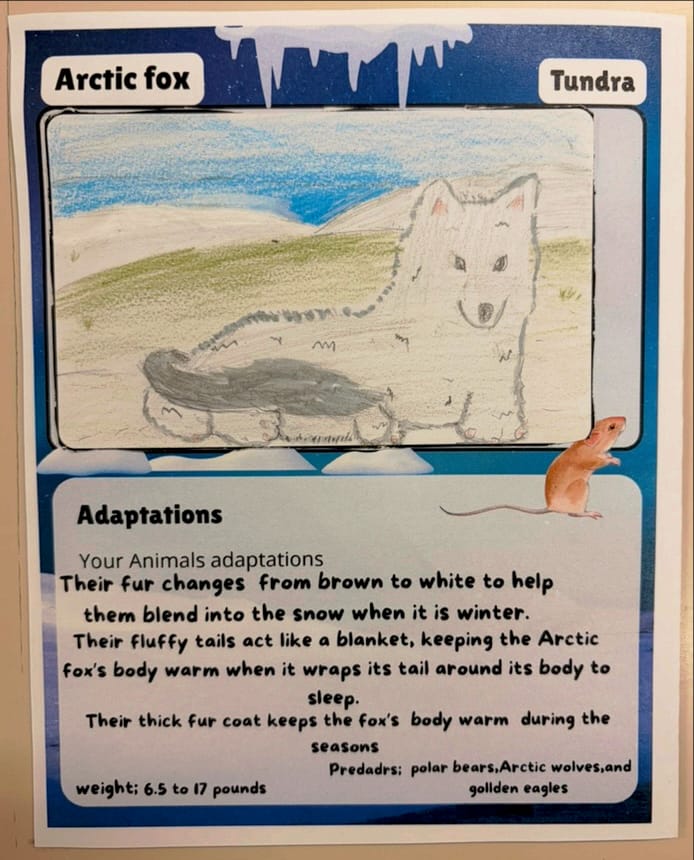
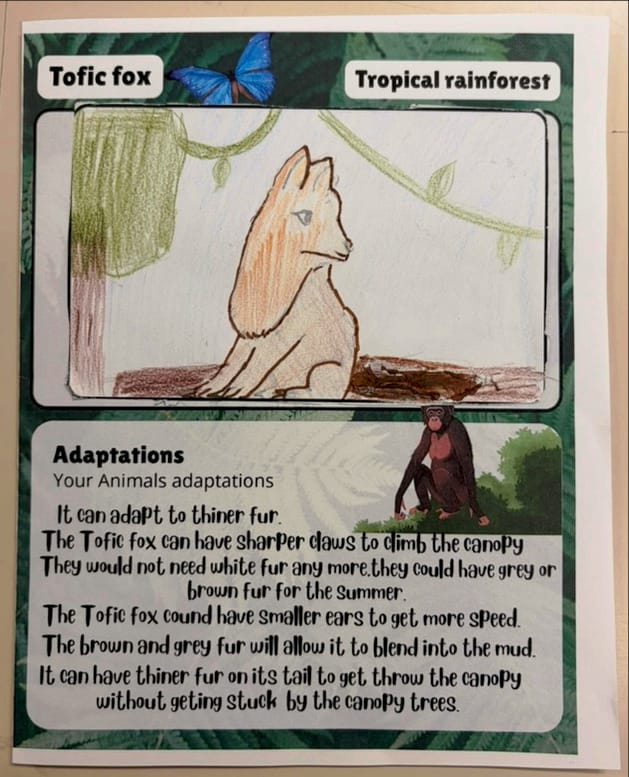
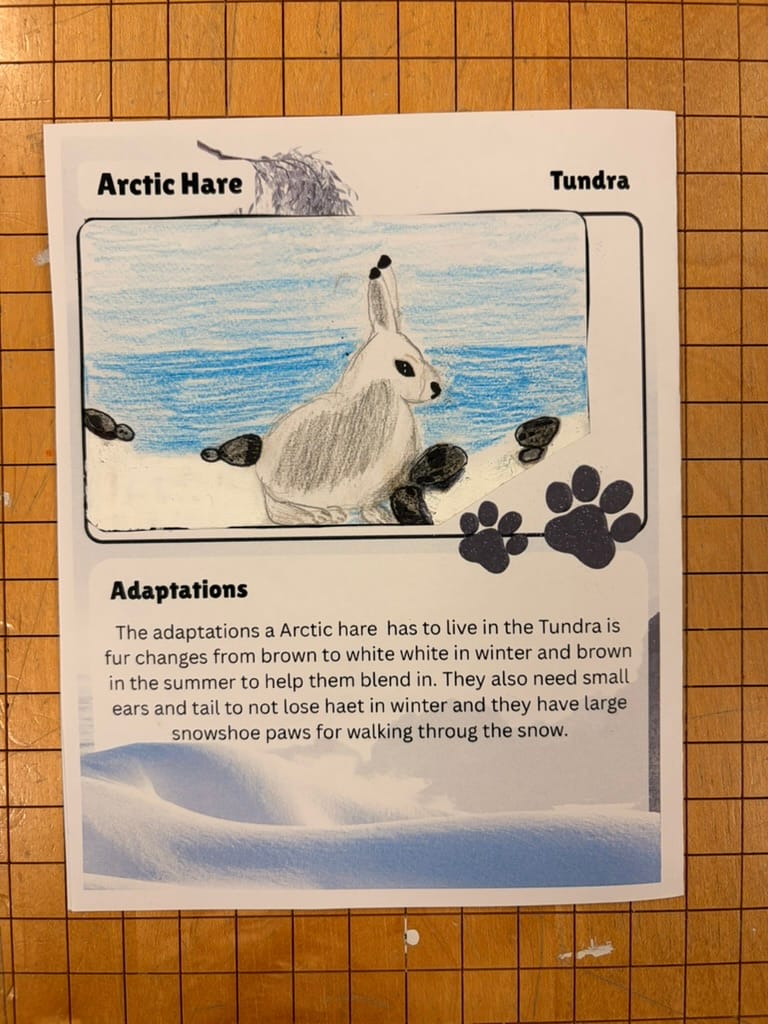
An Arctic fox that moved to the rainforest. A hare with gills on its ears. An orca living on the savanna. Taryn's Grade 4 class created a whole deck of cards featuring animals adapted to new environments.
If you've been reading for a while, you might remember Vol. 67. Natalie's Grade 4 class turned their animal adaptations research into trading cards featuring Pokémon style creatures adapted to specific biomes.
 Dylan
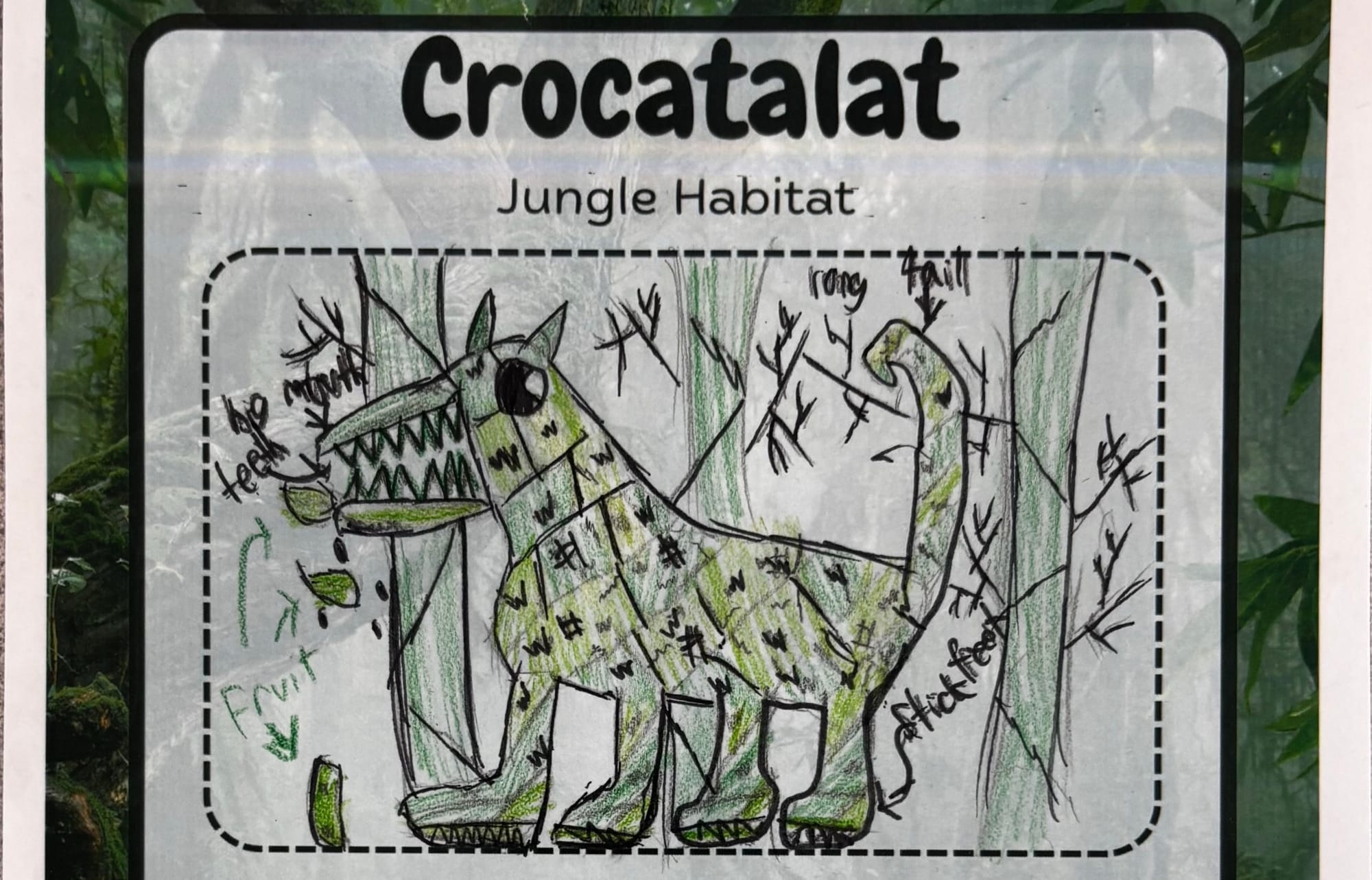
Last spring, Taryn's class was heading into their own animal adaptations unit, and she agreed to try a new iteration on the trading card concept. Here's the evolution of the project broken down into phases. And, at the end, a reflection on what I'd change this year.
Phase 1: Understanding Real Trading Cards 📝
We kicked off with a pile of real trading cards: Pokémon, sports, whatever students had at home. In pairs, students sketched a card's layout on blank paper and labelled every part they could find.
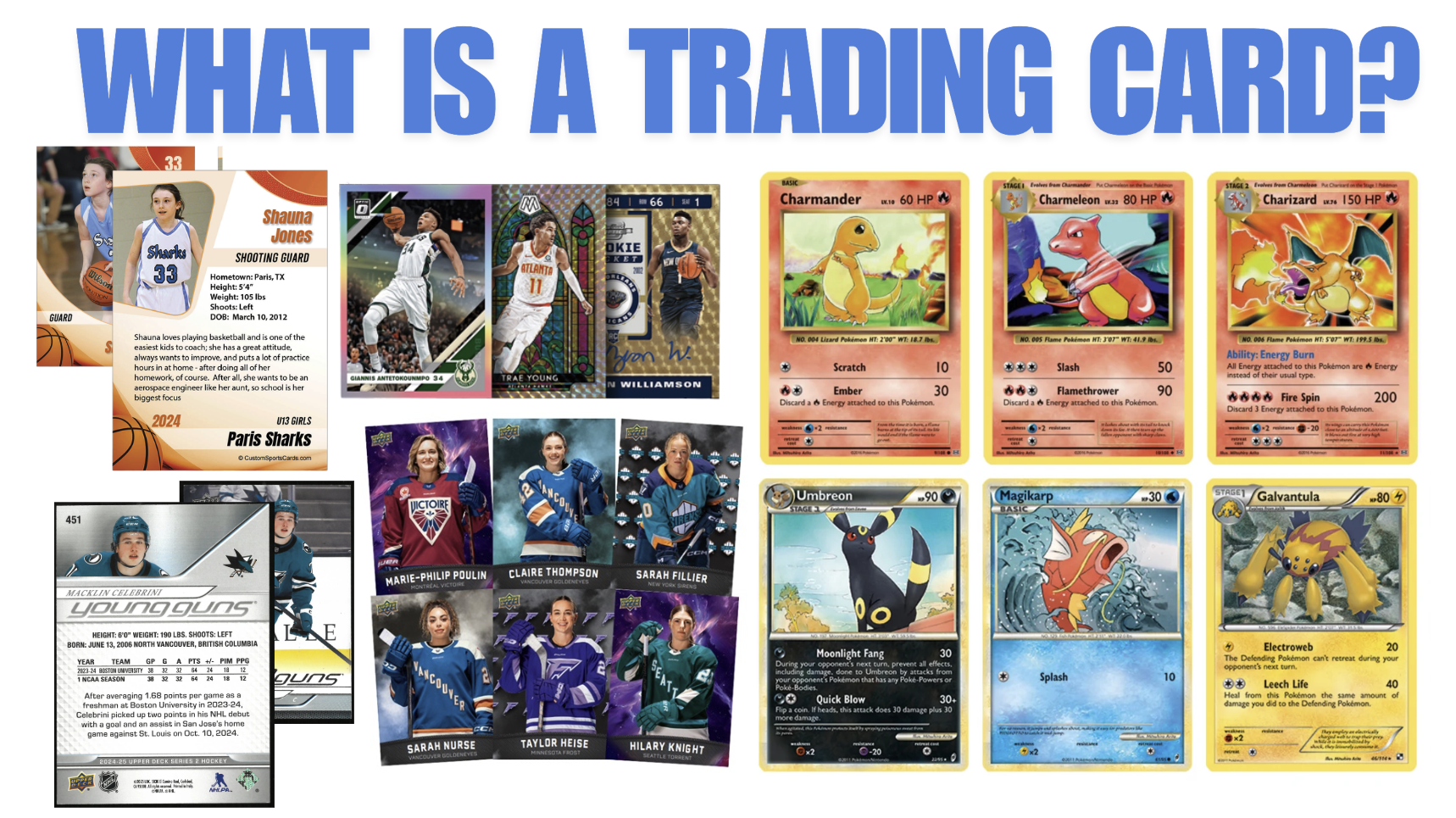
They noticed a lot. The graphics, and how each sports card was themed to match its team. The names. The stats. The text explaining what each Pokémon is capable of. From there, the class built a shared checklist of what their own cards needed.
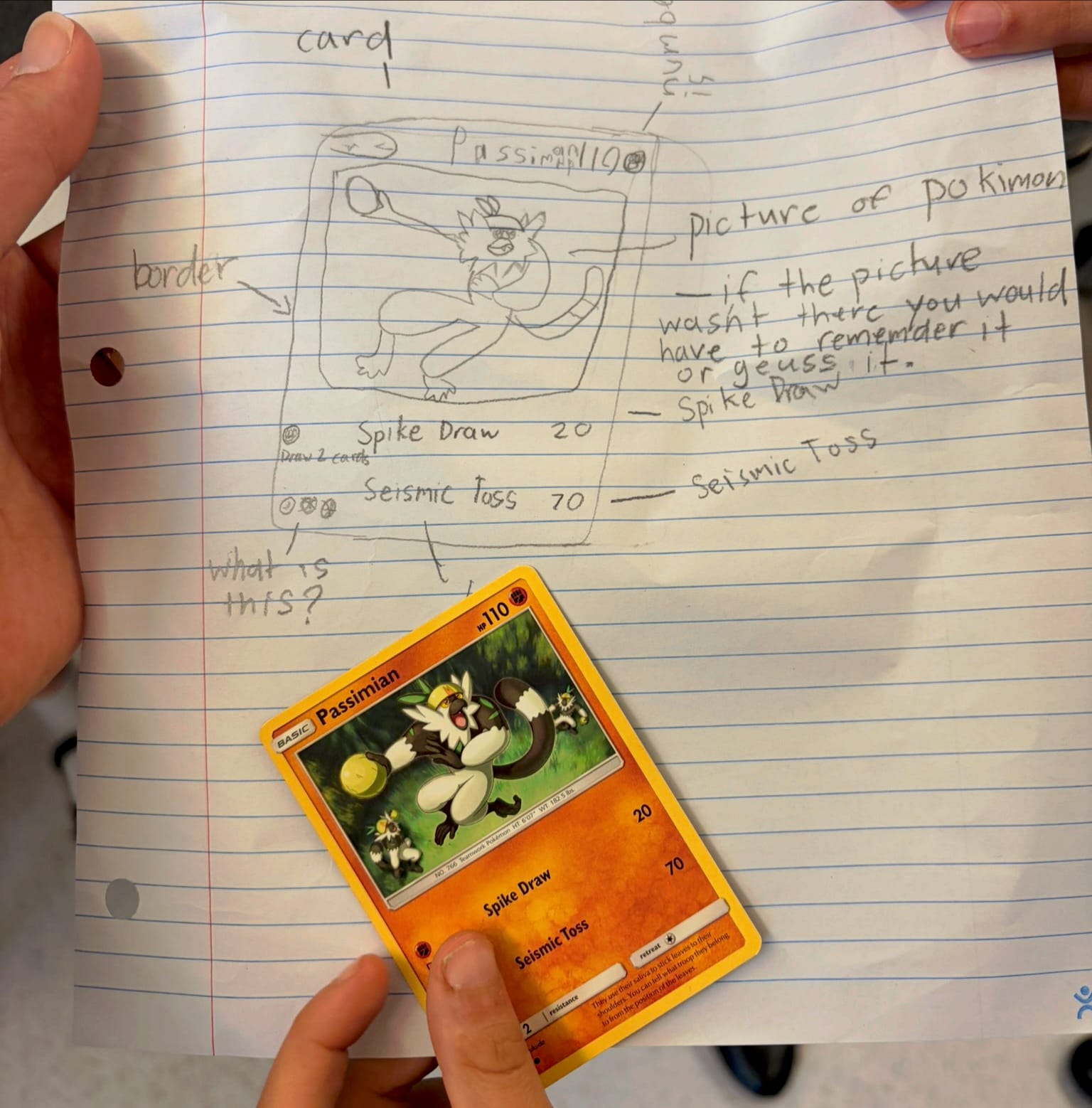
Then came the challenge: you're going to design your own creature. To do that, you first need to understand how real animals survive.
Phase 2: Field Researcher 🔎
Taryn led this phase over several classes. Each student picked a biome and an animal that lives there, then researched its structural adaptations (body parts) and behavioural adaptations (actions). Their findings went into a graphic organizer as short statements and bulleted lists.
This phase is knowledge recall. Students find out how a real animal survives in its biome and put it back in their own words. It's the foundation for everything after it. You can't evolve an animal for a new biome if you don't know why it survives in its current one, and the reasoning students do in Phase 3 only works if this research is solid.
Phase 3: Writer and Illustrator ✏️
Students turned their research notes into a paragraph for their first card: what their animal's adaptations are, and how each one helps it survive. We pushed for precise vocabulary like camouflage, nocturnal, and insulation.
Then came the knowledge transfer task, and this is where the Phase 2 research paid off. Students took what they knew about adaptations and applied it to a new situation. They moved their animal into a biome it doesn't live in and designed the adaptations it would need to survive there. The prompt we used was simple: "If this biome became colder, drier, or wetter, what would need to change?"
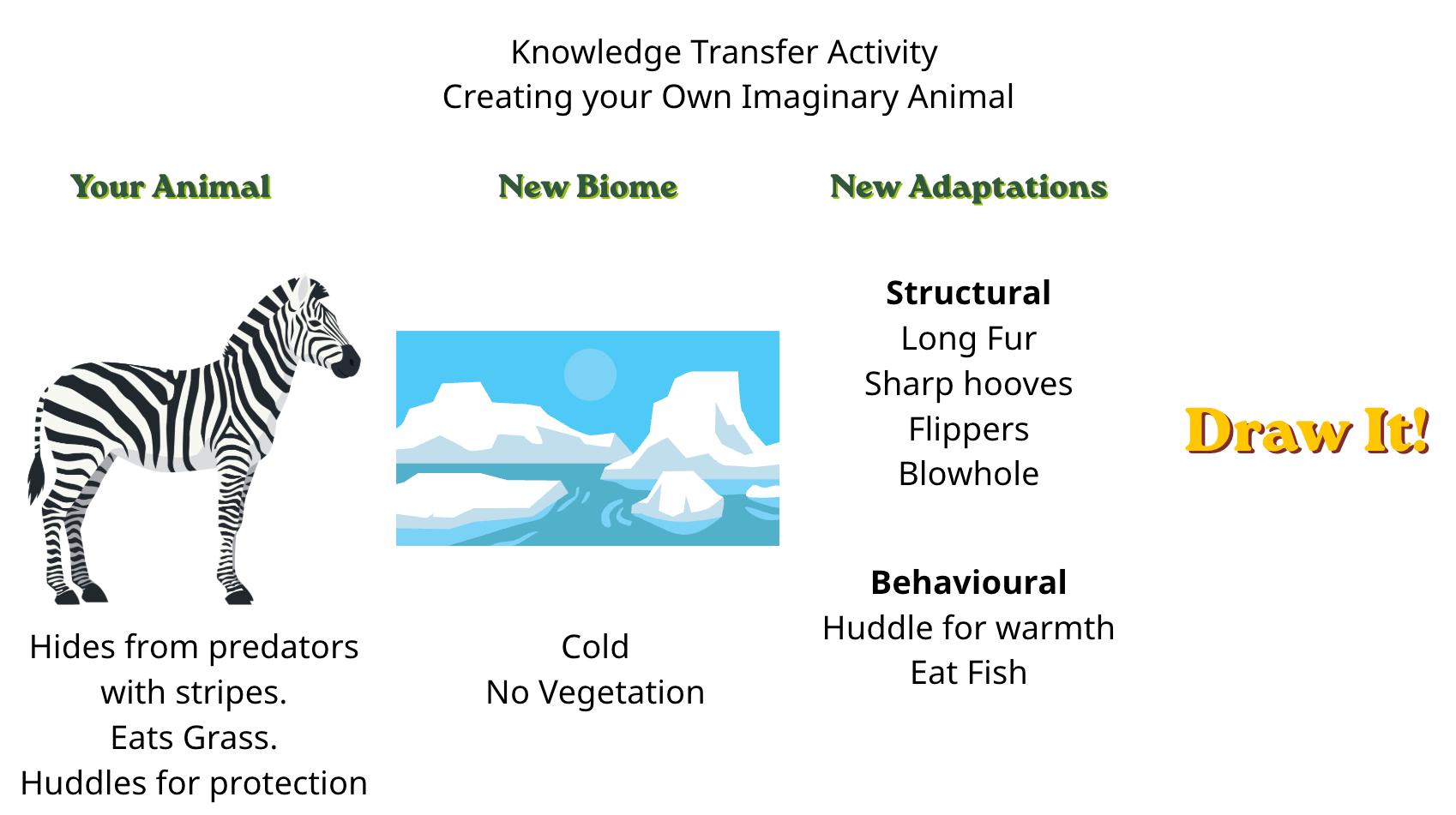
Our example was a zebra moved to the Arctic. Maybe it grows long, insulating fur. Maybe its hooves become wide like snowshoes. Maybe instead of herding to confuse predators, it huddles for warmth.
Reflection questions:
- What inspired your choice of adaptation?
- What helped you imagine your animal in a new environment?
Phase 4: Card Designer 🧑🎨
I led a Canva lesson on layers, text boxes, backgrounds, and duplicating designs. Then students moved their written adaptation descriptions into a card template. Taryn set up a Google Classroom assignment that handed out the template and collected the finished Canva files.
Their original animal artwork stayed on paper. Students hand-drew both animals on a handout sized to fit the image slot on the template, then cut the drawings out and later glued them onto the printed cards.
That was deliberate. We wanted students to feel connected to their animal, and drawing both versions makes them look closely at what physically changed. Canva is great for the layout, but for this kind of creative work, a pencil crayon is better!
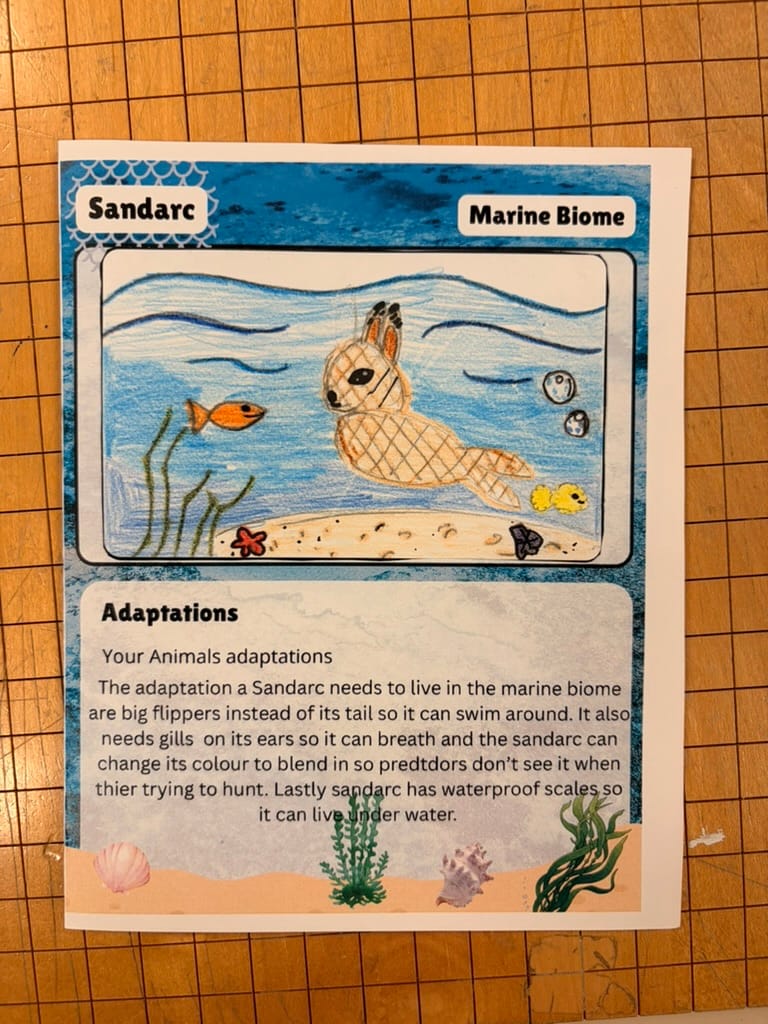
The Sandarc lives in the ocean. Its tail becomes big flippers for swimming. It has gills on its ears to breathe. Its skin is covered in waterproof scales. And it kept one trait from the original: it can change colour to blend in so predators can't spot it.
Taryn was really happy with the detail on these cards, and so was I! This was the kind of knowledge transfer we were hoping for. The student understood camouflage well enough to bring it into a completely different environment.
Phase 5: Printing and Assembly ✂️
After the cards were completed and the drawings were glued on, the card was folded so the real animal sits on one side and the evolved animal on the other. Taryn then laminated them to be glossy and flat so they feel like an actual deck of oversized cards.
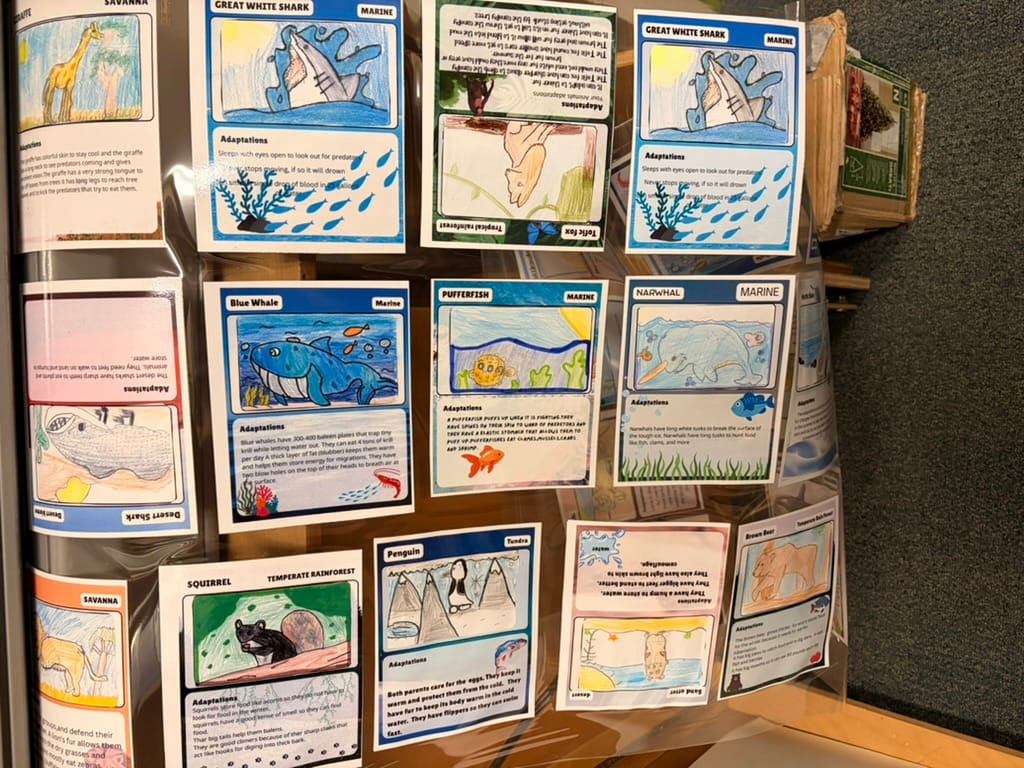
Phase 6: Handing the Animals to the Grade 1s 🤲
This part wasn't in the original plan. Partway through the project, I was chatting with Melissa, who teaches Grade 1. It turned out her class and Taryn's are buddy classes, she was about to start an animals unit, and a storytelling unit was coming up right after.
So we made a plan. The Grade 4s would bring their evolved animals down to their Grade 1 buddies, present them, and explain how their new adaptations help them survive. Then the Grade 1s would use those creatures as the main characters in their own stories.
The two classes weren't working on the same thing at the same time. Instead, the built on each other's work. And the Grade 4s got to see what happens when something they invented gets handed to someone else.
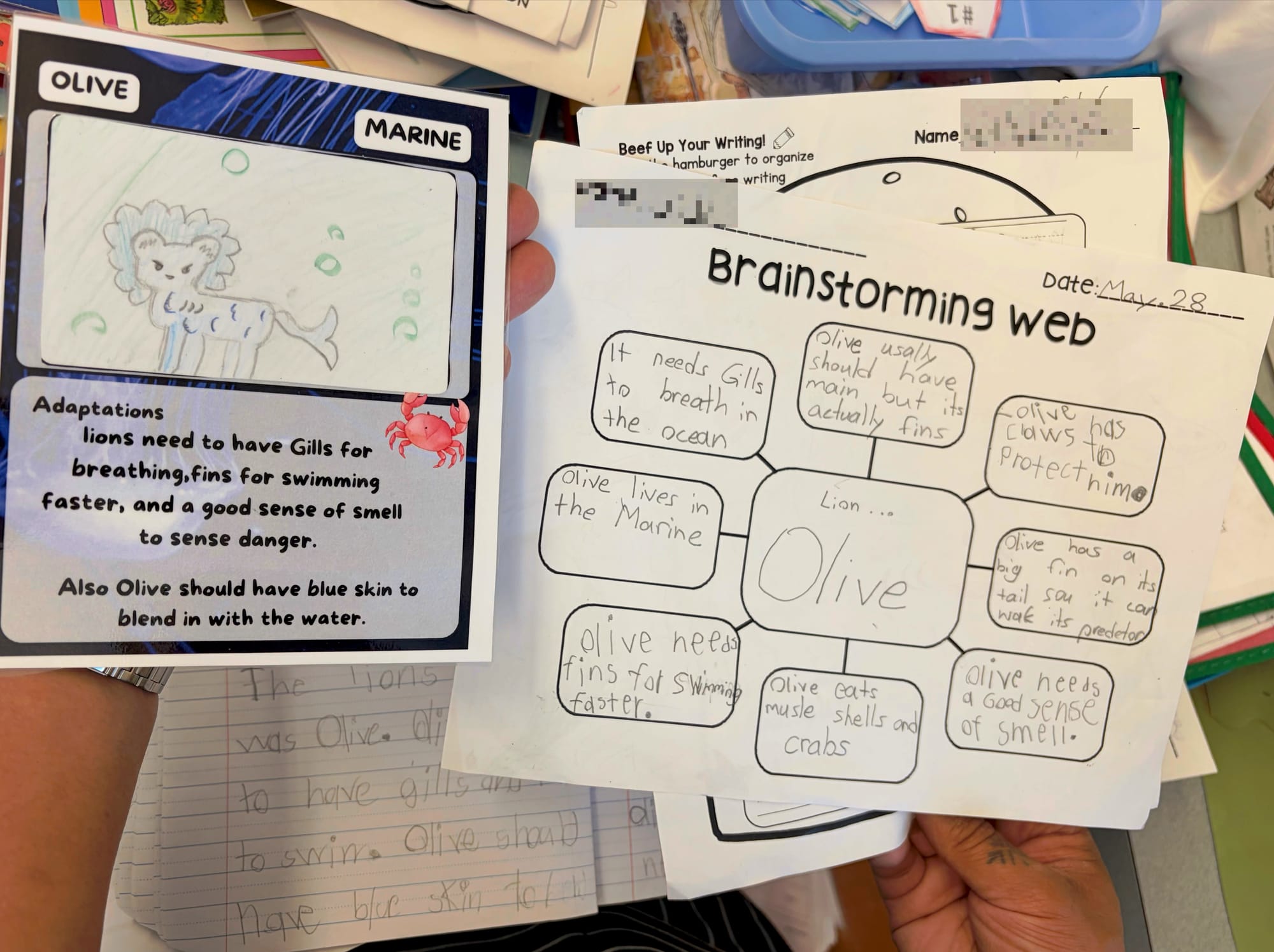
Melissa's class started with a brainstorming web for their animal, then planned a short story using a paragraph organizer with a topic, three details, and a conclusion.
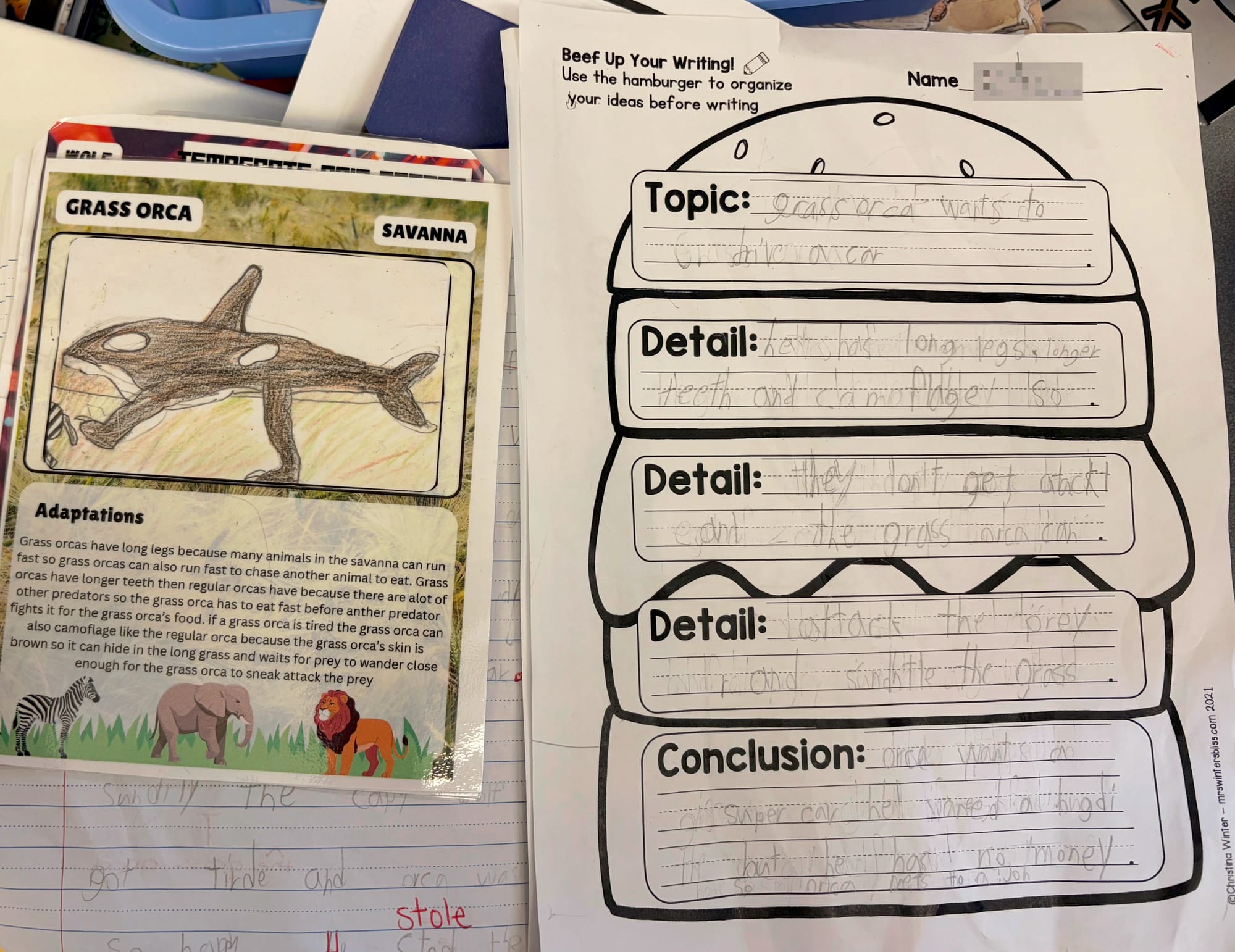
The Grade 1s didn't need to know what a behavioural adaptation was to write a great story about a Grass Orca. But the details on the Grade 4 cards gave them plenty to work with.
What I'd Do Differently Next Time 🔀
We already cut the stats, and I'd keep them cut. Natalie's version had a full stat block: strength, speed, smarts, attack, and defense. It was fun, but it pulled attention away from the actual learning. Students are working to understand how an animal's adaptations suit its environment. Balancing numbers for a game that doesn't exist was one thing too many.
Printing isn’t straight forward. Sizing and printing out of Canva was awkward. In the end, I had students submit their cards as PDFs in Google Classroom, then did all the page formatting in Preview on my Mac, and combined everything into one file to print. We printed two cards per page, with zoom set to “fit page”. Then folded the page in half, glued on the drawings and laminated the cards.
Recall and Reasoning 🧠
This project worked. Students recalled how a real animal survives, reasoned their way to a new version of it, and handed those animals to their Grade 1 buddies, who turned them into stories.
It isn't finished, though. Natalie's class taught us to cut the stat block. This one showed us that printing and assembly needs a simpler setup. The next class will show us more places to improve it. I’m looking forward to running it again and finding out how this project will evolve in the future. 😉